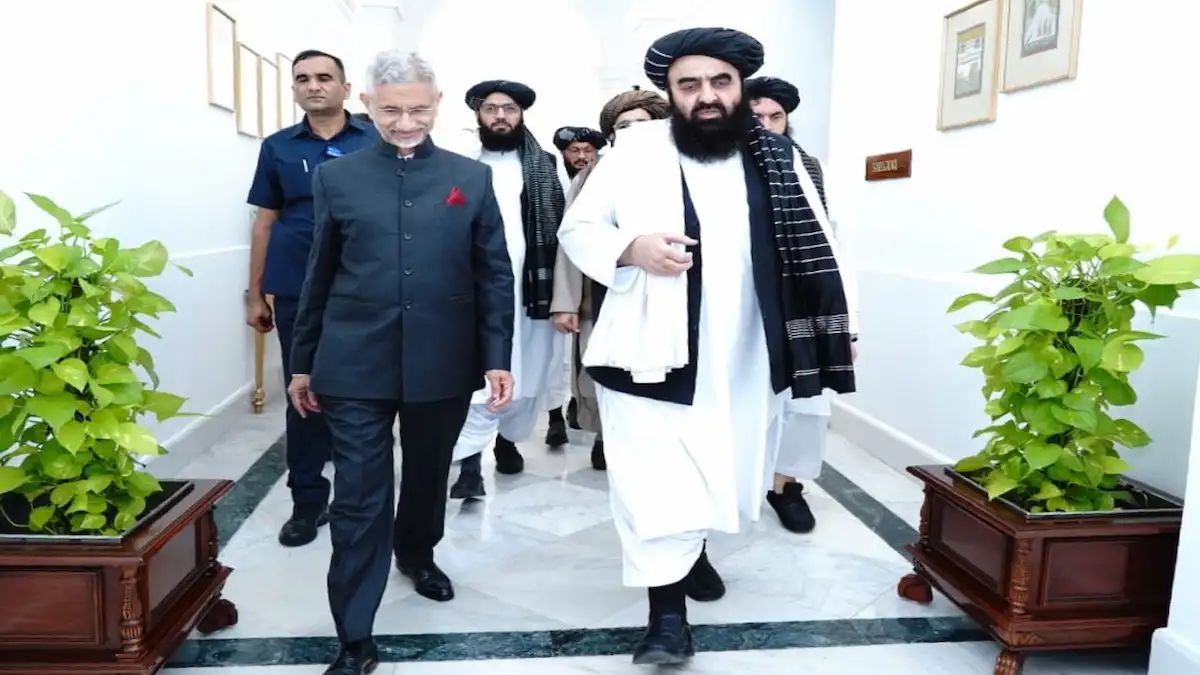
In a diplomatic move that underscores India’s evolving engagement with Afghanistan, External Affairs Minister S. Jaishankar today met with Afghanistan’s Foreign Minister Mawlawi Amir Khan Muttaqi in New Delhi. In his post meeting message on X (formerly Twitter), Jaishankar stated:
“Pleased to meet FM Mawlawi Amir Khan Muttaqi of Afghanistan today in New Delhi.
This visit marks an important step in advancing our ties and affirming the enduring India-Afghanistan friendship. Discussed India’s support for Afghanistan’s development, our bilateral trade, territorial integrity & independence, people-to-people ties and capacity building. India will upgrade its Technical Mission in Kabul to the status of Embassy of India.”
The meeting and announcement mark a significant shift in India’s Afghanistan policy, reflecting a cautious but deeper diplomatic outreach to the Taliban-led administration in Kabul.

High-Level Engagement after Years of Distance
Muttaqi’s visit to India is the first high-level trip from Kabul since the Taliban takeover in August 2021. His entry was made possible via a temporary travel exemption granted by the UN Security Council, since he remains under U.N. sanctions including travel bans and asset freezes. During the visit, he is expected to meet senior Indian officials, as well as engage with business leaders and visit cultural and educational institutions.
India had already engaged with Afghan representatives in lower level or indirect channels, for instance, a meeting between India’s Foreign Secretary Vikram Misri and Muttaqi in Dubai earlier this year. But this visit is the first public, high-visibility encounter.
Darul Uloom Deoband Visit & Other Itinerary Highlights
As part of his approximately week-long stay in India (October 9-16), FM Muttaqi has several engagements beyond formal talks, adding symbolic and people-oriented dimensions to the trip. Some of the key non-diplomatic and cultural parts of his itinerary include:
- Visit to Darul Uloom Deoband
Muttaqi is scheduled to spend about four hours at Darul Uloom Deoband, one of the most prominent Islamic seminaries in India, located in Uttar Pradesh. The visit is expected on October 11, 2025. This seminary is historically important for the Deobandi school of thought, which also significantly influenced the ideological formation of the Taliban. His visit carries symbolic weight, reflecting a recognition of religious, educational, and cultural dimensions as part of India-Afghanistan people-to-people links. - Visit to the Taj Mahal in Agra
As part of the cultural component of his itinerary, Muttaqi will also travel to Agra to see the Taj Mahal. This underscores a diplomatic gesture of cultural respect and tourism diplomacy. - Meetings with Indian leadership beyond the Foreign Ministry
In addition to meeting with EAM S. Jaishankar, Muttaqi is expected to hold talks with National Security Advisor Ajit Doval. He will also interact with Indian business leaders and the Afghan diaspora/community in India.
What Was on the Table: Key Themes of the Discussion
During their talks, Jaishankar and Muttaqi covered multiple strategic and developmental themes, many of which echo India’s traditional interests in Afghanistan. Some important focus areas include:
- Development and humanitarian assistance
Jaishankar reaffirmed India’s “deep interest in Afghanistan’s development” and announced that New Delhi would commit to six new development projects. He also formally handed over five ambulances to Afghanistan as a symbolic step of a larger gift of 20 ambulances, along with plans to provide MRI/CT machines, immunization vaccines, cancer medicines, and medical supplies. India further pledged to continue its longstanding humanitarian and food aid to Afghanistan. - Sovereignty, territorial integrity, and noninterference
Jaishankar reiterated India’s commitment to Afghanistan’s sovereignty, territorial integrity, and independence. On his part, Muttaqi assured that Afghanistan would not permit any group to use its territory to threaten other states, pledging that Kabul would act responsibly in regional security. - Bilateral trade, investment and connectivity
The two ministers discussed ways to expand trade, with special emphasis on connecting Afghan commerce to Indian markets. Muttaqi is reported to have invited Indian firms to explore investment opportunities in Afghanistan’s mining sector and other infrastructure areas. Given India’s landlocked access via Pakistan, optimizing regional connectivity and transit routes will be an important challenge. - People-to-people ties, capacity building, and education
Jaishankar emphasized India’s commitment to capacity building, education, and cultural exchanges. India also plans to expand visa issuance to Afghan citizens, particularly in medical, business, and student categories and increase flights to Kabul to boost connectivity. - Security cooperation and counter-terrorism
A key topic was countering terrorism in all its manifestations. Jaishankar emphasized coordinated efforts between India and Afghanistan, underlining that security threats respecting no boundary must be jointly confronted. The Indian side also referenced past instances, such as solidarity shown by Kabul after the Pahalgam terrorist attack, to reaffirm cooperation
Diplomatic Recalibration: Mission Upgrade Signals Deeper Engagement
Perhaps the most striking outcome of the meeting was Jaishankar’s announcement that India will upgrade its existing Technical Mission in Kabul to a full-fledged Embassy of India. This signals a step toward restoring full diplomatic presence, something that India had suspended following the Taliban’s takeover.
While precise timelines for reopening have not been made public, Indian media and analysts describe it as a symbolic and structural reorientation of India’s approach in Kabul. The upgrade underscores India’s willingness to invest in institutional presence and responsiveness if dialogue with Kabul proceeds constructively.
Analysts see this as India’s calibrated recognition of on-ground realities in Afghanistan without formally recognizing the Taliban government. Indeed, as of mid-2025, only Russia is formally recognized by the Taliban regime; most states including India maintain relations on a de facto basis without extending de jure recognition.
In its earlier engagement strategy, India reopened a small mission in Kabul in 2022, primarily to manage humanitarian and aid effort. This newly announced upgrade goes further, placing full diplomatic weight behind India’s Afghan policy.
Challenges & Strategic Considerations
While the announcement is bold, it carries multiple challenges and implications:
- Legitimacy and recognition constraints
India has so far avoided formal recognition of the Taliban regime, given the government’s controversial domestic record, especially regarding women’s rights, inclusiveness, and human rights. The upgrade of the Indian mission signals a pragmatic tilt, but India will likely continue to tread cautiously. - Security and stability risks
Afghanistan continues to face significant internal security threats from groups like ISIS-K, as well as factionalism within the Taliban itself. Ensuring the safety of Indian diplomats and staff would be a major consideration. - Connectivity and logistics
Direct overland trade between India and Afghanistan must traverse Pakistan, diplomatic and logistical constraints here complicate smooth economic links. India may increasingly rely on transit routes via Iran’s Chabahar Port to circumvent this challenge, as has been discussed in prior engagements. - Regional ripple effects
Pakistan may view India’s heightened engagement with suspicion, especially amid tensions over cross-border militancy. Indeed, India and Afghanistan during the meeting described Pakistan-sponsored cross-border terrorism as a shared threat. China, which already has growing economic presence in Afghanistan, may also observe India’s moves carefully. - Domestic and international optics
India must balance the optics of engaging with the Taliban government while retaining moral and normative space to critique policy decisions internally within Afghanistan, especially on rights issues. Moreover, as other regional powers (China, Iran, Russia) expand ties with Kabul, India’s move aims to prevent being left out of Afghanistan’s evolving regional architecture.
What This Means Going Forward
Jaishankar’s meeting with Muttaqi and the upgrade to a full embassy signal a turning point in India’s diplomacy toward Afghanistan. While not tantamount to formal recognition, it reflects an intent to engage more deeply, on trade, development, health, and regional security.
For Afghanistan, the outreach offers a chance to tap into India’s technical, human, and infrastructural strengths. Muttaqi’s assurances of nonthreat behavior and commitment to sovereign diplomacy aim to reassure India, and potentially open a path for more stable bilateral cooperation.
Much will depend on how both sides translate rhetoric into sustained projects, governance partnerships, and tangible connectivity. The road ahead is fraught, but today’s meeting marks a recalibration, not a revocation, of India’s Afghan policy.

