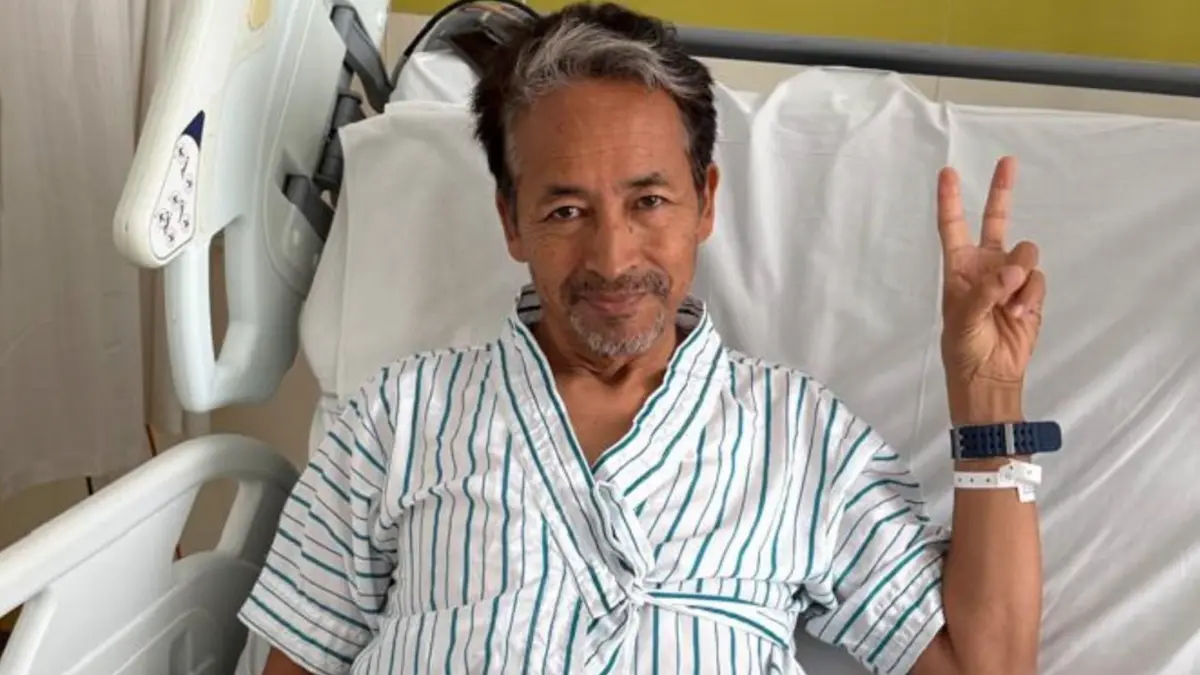

India’s handling of Sonam Wangchuk’s recent hunger strike raised a serious constitutional question that extends far beyond a single protest. By justifying his forced hospitalization solely based on his deteriorating health, while failing to demonstrate the same urgency in engaging with the grievances underlying the strike, the State reduced a hunger strike as a political act of dissent to an ordinary medical emergency. Before this approach settles as a legitimate precedent for India’s response to another hunger striker, it deserves constitutional scrutiny.
A Hunger Strike Is More Than a Medical Emergency
After prolonged fasting for 26 days, Climate Activist, Engineer-Innovator and Ramon Magsasay Awardee Mr. Sonam Wangchuk recently concluded his hunger strike at Medanta Hospital, Gurugram, in the presence of Union Ministers J.P. Nadda and Jitendra Singh, following assurances from the Indian government that the demands underlying the nationwide protest calling for educational reforms and institutional accountability would receive due consideration. As a historic win, the protest culminated in the resignation of the erstwhile Union Education Minister Dharmendra Pradhan, alongside a series of government-promised initiatives to address the lack of robust examination infrastructure.
Yet, this hard-earned victory does not settle the central constitutional question left unresolved in the wake of the protest. The legality of Mr Wangchuk’s forced hospitalization by the police at Safdarjung Hospital, New Delhi, during the course of the protest deserves a principled constitutional scrutiny before it is legitimized as the appropriate State response in the case of future hunger strikes. The question, therefore, is: when a competent hunger striker chooses to risk his life in exercise of his fundamental right to protest, can the State compel hospitalization to preserve his life regardless of his decisional autonomy, without simultaneously undertaking timely engagement with the underlying grievances?
The open-ended order dated 16.07.2026 pronounced by the Delhi High Court in Rakesh Kumar Saini v. Union of India conferred unbridled discretion upon the State to override Mr Wangchuk’s consent by ‘whatever medical intervention’ it considered suitable. Acting upon the order, the State hospitalized him, and the judiciary declined to declare it arbitrary based on his deteriorating health. A subsequent order dated 21.07.2026 in Gitanjali J. Angmo v. Union of India & Ors. went a step further by not only authorizing administration of medication as may be required, but also directing Mr. Wangchuk to ‘abide by’ the attending doctors’ decision.
While these developments invited widespread criticism from civil society as political moves orchestrated to suppress the protests maliciously, they also highlighted the State and judicial consensus on the State’s obligation to save life under Article 21 of the Indian Constitution taking precedence over a competent hunger striker’s autonomy to refuse medical treatment. Additionally, the omission to give any simultaneous assurance to engage with the underlying grievances disproportionately overshadowed the right to protest guaranteed under Articles 19(1)(a) and 19(1)(b) of the Indian Constitution in favor of the State’s obligation to save life.
Against this backdrop, it becomes imperative that this episode is examined not only as a political event, but also through the lens of legal and constitutional philosophy.
Rethinking the Constitutional Response to Hunger Strikes
The constitutional premise underlying the judicial approach towards this matter was adequately reflected in the observation made by Justice Pushkarna in her 19.07.2026 order in Gitanjali J. Angmo v. Union of India & Ors., where she noted ‘…. the fact that Mr. Sonam Wangchuk was taken from the site of protest to a hospital, does not prima facie infringe the personal liberty of Mr. Sonam Wangchuk, as the said step was taken in furtherance of protection of his life in view of his vulnerable medical condition on account of prolonged fasting.’ This reasoning warrants constitutional debate, as by giving primacy to the State’s duty to preserve life without adequately engaging with the decisional autonomy of a competent hunger striker, it treated the hunger strike as an ordinary medical emergency, even when it was more of a political expression of dissent, liberty and bodily autonomy.
This episode also demonstrates that this controversy cannot be viewed through the conventional lens of an Article 19 versus Article 21 conflict. This is because, unlike cases where the exercise of one person’s freedom of speech and expression directly impairs another’s rights under Article 21, Mr. Wangchuk’s strike presented no such zero-sum constitutional choice. The State’s obligation to preserve life did not prevent it from timely engaging in good faith with the underlying grievances.
Democratic Paternalism Requires Democratic Engagement
Furthermore, as problematic as it is to suggest that the State should abandon a competent hunger striker to his fate, equally problematic is the narrative that the individual’s right to bodily autonomy and the State’s obligation to preserve life are necessarily at loggerheads in such cases. It is a false conflict that needlessly invites prioritization or ranking of constitutional values when reconciliation is available as a more suitable solution.
However, such reconciliation becomes feasible only when the State chooses democratic paternalism, which not only obliges it to preserve life but also places it under a ‘bounden duty’ to engage in meaningful dialogue with the citizenry and hold itself accountable at the right time, over Hobbesian paternalism which characterises its subjects as prone to self-endangerment justifying coerced protective care.
In retrospect, while the haste shown by the State in preserving an indeed ‘precious life’ is appreciable, it is more worthy of a vibrant democracy if the same urgency had been shown in protecting the dignity and agency of the protestors, through timely and good-faith consideration of the concerns underlying the protest. This did not require the government to concede to every demand raised through the hunger strike, but only to accord such demands meaningful and timely consideration which they indubitably deserved.
Additionally, the judiciary could have drawn from the approach it had adopted while specifically directing the hospitalization of Mr. Jagjit Singh Dallewal in 2024, who had similarly undertaken a hunger strike in support of the farmers’ demands. A perusal of the order dated 18.12.2024 in State of Haryana & Anr. v. Uday Pratap Singh & Ors. conveys that, instead of conferring sweeping authority upon the State to undertake “whatever medical intervention” it deemed fit, the Court directed hospitalization only after being satisfied of its necessity based on his age, ailments and expert opinion. Furthermore, by simultaneously inviting the farmers’ demands for consideration in consultation with all stakeholders, the Court also treated the preservation of life as complementary to, rather than detached from, meaningful democratic engagement.
Reimagining the State’s Duty Towards Hunger Strikers
Although the hunger strike has now concluded and the government has initiated dialogue with the protestors, what preceded this outcome should not become a precedent for future hunger strikes. The entire episode calls for a principled constitutional deliberation on the ideal State’s response to hunger strikes, that adequately balances its obligation to preserve life while ensuring that the urgency of medical intervention does not overshadow the constitutional right to protest.
The premise that the State and doctors may assume authority over a competent hunger striker’s body once his health deteriorates neither does justice to the underlying cause, nor sits well with the settled principles of medical ethics, which unequivocally recognize the freedom from non-consensual medical intervention as a core component of the right to health. The proposition is supported by Article 7 of the International Covenant on Civil and Political Rights (ICCPR), Article 12 of the ICESCR, and the ethical guidance of the ICRC.
The WMA Declaration of Malta on Hunger Strikers explicitly mentions that beneficence for physicians is not just acting in a rational patient’s clinical interest, but is also respecting his bodily and decisional autonomy above everything else. Disregarding this direction only reinforces what Mr. Wangchuk aptly said, ‘They don’t understand that this is not a disease or disorder. This is a self-chosen path.’
About Authors-
- Kritika Dua is a penultimate-year B.A. LL.B. (Hons.) student at Rajiv Gandhi National University of Law, Punjab
- Anureet Kaur is a penultimate-year B.A. LL.B. (Hons.) student at Rajiv Gandhi National University of Law, Punjab.